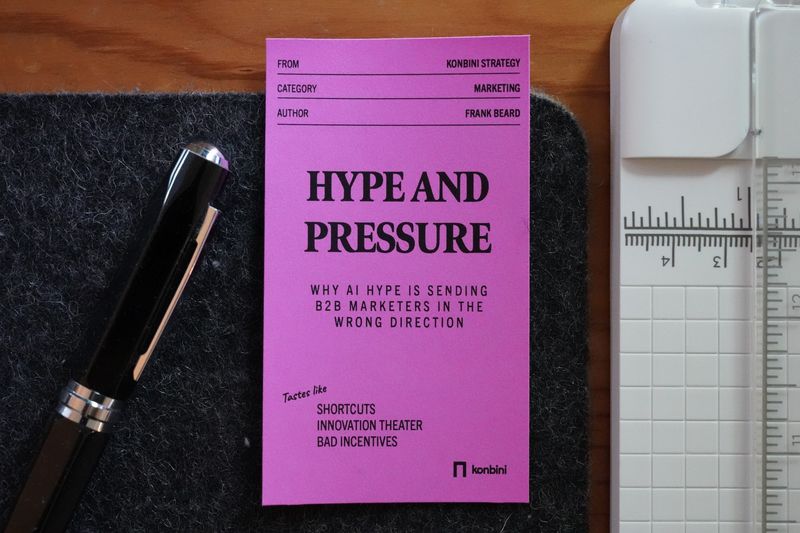
This is the second post in a three-part series on the impact of AI in B2B marketing. Part 1 examines what’s changed in the past year, Part 2 takes a closer look at why, and Part 3 explains why the organizational structures at some companies make it hard to correct for this. I wrote this myself as one should always do, so don’t be fooled by the presence of em dashes. I’ve overused them for the past twenty-five years and don’t plan to stop.
A lot of people feel like we’ve passed an inflection point with AI as it relates to workplace productivity, and I wouldn't necessarily disagree with that.
The discourse on AI hit a proverbial fork in the road late last year after Opus 4.5 dropped on November 24th—which was coincidentally my 40th birthday, not that that matters. But it was interesting to observe the vibe shift throughout December on platforms like Twitter, where I spend entirely too much time consuming opinions on tech.
This post from January 4th kind of sums it up:
this is it. tomorrow is monday. everyone will return to work. their founder/ceo has been tinkering with claude code over the holidays and had an epiphany after experiencing vibe coding first hand. they will mandate that every employee, engineers and non-engineers, begin…
— 0xDesigner (@0xDesigner) January 4, 2026
The funny part is I actually know people who experienced that exact scenario the next day. And if I’m being honest, there’s a part of me that kind of gets it. I personally think Claude Code is cool as hell. The first time I really dug into it, I had so much fun that I stayed up until almost 4:00 in the morning. It dredged up the kind of joy I used to feel back in high school when I was obsessed with web development.
And while there’s still a lot of junk out there when it comes to AI—and I’m looking at you, everyone who lazily drops a chat box into your SaaS tools—what’s available from the likes of Anthropic and others has moved from “this will be good someday” to “I can do work with this right now,” and, more recently, “this can do work for me.”
So what’s a person to do about that?
Feeling pressured to do something
Nobody ever wants to feel like they’ve Fallen Behind™. Right now, however, there’s intense pressure—both real and perceived—for individuals and companies to performatively signal that they’ve ‘got this’ when it comes to AI. How many times have we all been told that if you don’t do something, your competitors will run laps around you or that someone else using these tools will take your job? It’s all fear tactics, of course, and rarely does anyone saying these things ever follow-up with specifics about how any of that would even happen. But the rhetoric does land, and it does contribute to anxiety about what this technology means for one’s place in the world.
The reality is that the needs and use cases for AI will vary from one person and profession to the next. It makes sense why my developer friends rave about AI, because software development aligns remarkably well with AI’s strengths. But not every problem is a software problem. For other professions, the opportunities may not be as obvious. Forcing people to use these tools without training or well-defined use cases may even risk ‘innovation theater’ at best or counterproductive outcomes at worst.
But even if you’re just using Claude to review some contracts or analyze a few spreadsheets, you can’t exactly take that to LinkedIn and flex. It’s not 2024 anymore, and the discourse has moved far beyond that. If you’re a business leader listening to your peers vagueposting about how AI has transformed their operations, how they’re “AI-native” without sharing specifics about what that means, or you’re sitting through a session at a conference where a consultant serves up buzzword soup and tells you that Everything Has Changed™—well, you might feel pressured to do something if for no reason other than to feel better about yourself and signal to others that you are, in fact, actually doing something.
That’s why when I when I read things like this fantastic piece from Rachel Karten—describing how a lot of marketers are frustrated with leaders who’ve outsourced their judgement to Claude and ChatGippity—part of me wonders if maybe that’s to some degree a story of people who are so desperate to do something that they’re looking at AI like it like it's a hammer and everything else is a nail.
Which might explain why I recently sat through a presentation at a conference that was clearly written by AI. Just straight-up slop, word-for-word, totally indistinguishable from the LinkedIn posts that we all privately complain about. The sad part is I actually like and respect the person who gave that presentation. But when you scrub away your voice and replace it with Claude’s or ChatGippity’s, you’re selling yourself short and undermining everything that qualified you to be on that stage in the first place. And it’s disrespectful to the audience, since you’re asking them to sit through something that you didn’t even write.
Personally, I stopped listening and opened up the app formerly known as Twitter to find something else to get upset about. The whole thing was weird and awkward, but I was sitting up front near the stage and couldn’t walk out without being seen.
Poisoning the well
Obviously much has been written lately about how companies are forcing employees to use AI tools, or even monitoring token usage to make sure they’re using them. And yes, I think most rational people—including those of us who do enjoy using AI tools—can agree that it’s generally stupid to do these things outside of certain circumstances. I’m obviously not talking about development teams that revamp their workflows.
But a lesser-discussed issue is what happens inside an organization when the boss becomes a human GPT wrapper. I’ve spoken with several people who’ve expressed frustration about business leaders who can’t make decisions anymore without first consulting Claude like it’s some sort of oracle. On one hand, this is difficult since folks generally want to trust that the ship’s being steered by people with good instincts. But on the other hand, this can create anxiety and uncertainty about what’s even expected from individuals and their teams.
Imagine for a moment that you’ve been hired to do a job, you’ve developed a workflow that works, and you’re getting great results. But then all of a sudden, your boss gets a bit euphoric, speaks prophetically about AI in every company meeting, and doesn’t seem to be interested in talking about anything else. What do you think is more likely: that your boss will respect your decision to keep doing what is already working, or that they’d be happier if you built a new workflow around Claude? Most people are going to follow whatever incentives result in keeping their jobs, and they might interpret the incentives as having changed even if there has been no communication about any new or different expectations.
That’s why at a certain level, I’m not surprised to see some companies suddenly filtering all of their marketing and creative through these tools. I hesitate to use contrastive framing since it’s all over that kind of content; but it’s not just that marketers are doing this because they think it’s the right thing, many are doing it because they think it’s what’s expected of them. And in some cases, they are being told that it’s exactly what’s expected of them.
The risk here, of course—beyond the effects of bad marketing—is that someone who previously took pride in their job may decide to just ride it out and stop putting in the extra effort. Or they might throw in the towel and start looking elsewhere.
It's time to get good
It bears repeating that I enjoy using AI tools. I just use them for some things and not others. You’ll hear me say this a lot, but: AI is a great tool, it’s just not the right tool for everything.
Unlike most folks who vaguespeak about use cases, I’m happy to share a few specifics. I’m working with one company where Claude has made it so much easier to get data directly from the client success team. I was able to do something about a week ago that a decade ago would have meant emailing a data scientist, waiting a full week, and then having to go back and forth with additional requests. Instead, the client success manager gave me what I needed and even refined it a bit over the course of a 30-minute video call.
I’ve also seen examples of how AI tools have enabled people with unique domain expertise to translate it into something like a vibecoded mockup of a dashboard—making it significantly easier to give direction to the engineering team and arrive at something that’s tailored to a specific type of user. I’m working with a stealth startup right now that’s saved a lot of time doing this.
Or in my case, I built this website in Claude Code. I was actually on the fence about doing that and debated just building it in Framer or Webflow—or paying someone to build it for me. But I wanted to move quickly, and it honestly sounded like a lot of fun. Especially since I learned about a few new things like Eleventy and Netlify, and was able to treat the whole thing as an educational experience by giving Claude a detailed history of what I’d done years ago when I was actively involved in web development. I think I ended up with a good stack involving Eleventy, Netlify, GitHub, and a headless CMS that I’ve made a few modifications to.
So again, I’m not anti-AI by any means. It’s just that we’re in a situation where a lot of companies are using these tools incorrectly—and undermining their marketing and communications. Fortunately for everyone else, this is an opportunity to get better and stand out even more. The only defense against slop, after all, is craft and quality.
But let’s move on to Part 3 and examine why, for some companies, the organizational structure can make it hard to adjust to this reality and focus on what actually makes a difference. You can also click here to get caught up if you missed Part 1.