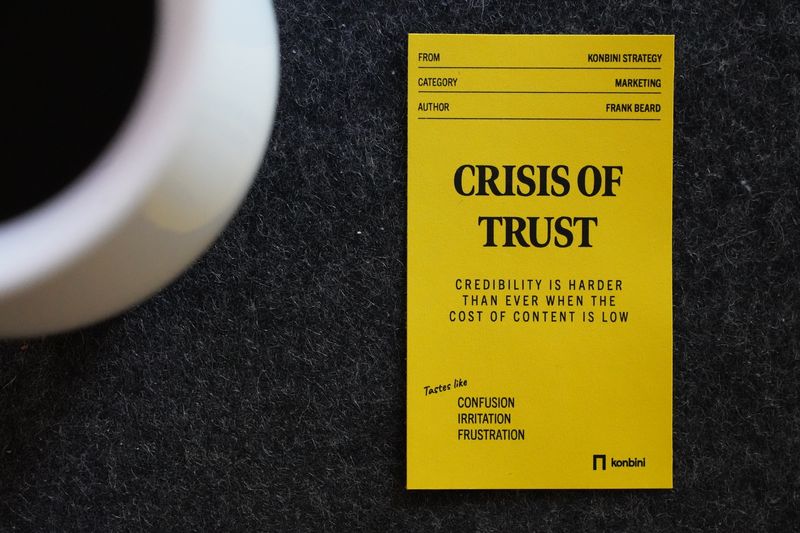
This is the first of a three-part series on the impact of AI in B2B marketing. Part 1 examines what’s changed in the past year, Part 2 takes a closer look at why, and Part 3 explains why the organizational structures at some companies make it hard to correct for this. I wrote this myself as one should always do, so don’t be fooled by the presence of em dashes. I’ve overused them for the past twenty-five years and don’t plan to stop.
A few years ago, I visited a company’s booth at a trade show and realized that I didn’t believe anything they were saying.
The problem was that I’d spent time in the autonomous checkout industry and knew how costly and difficult it was to build that kind of technology. So when this company told me that they had similar computer vision capabilities—things that were really only possible if their platform was sophisticated enough to do autonomous checkout—I was immediately skeptical.
One of the main issues was their claim that they could use retailers’ existing cameras. The problem is those cameras are typically too few in number and sometimes too low in resolution. They’re also placed for use cases like loss prevention and lack the coverage required to accurately track the movement of products and people throughout the store. And on top of that, this vendor had only raised about 1% - 5% of the funding raised by similar companies.
Was it possible that they just cracked the code and figured out what everyone else had missed? I suppose so, but I didn’t think that was probable.
The challenge in these situations is that nobody can independently verify every claim a company makes about its capabilities. For buyers, it may be impossible to know until you’re several months into a pilot project. So at a certain point, you just have to decide: Can I trust these people?
That's where marketers come in.
How it used to be
People tend to think of B2B marketing as a lead-generation function, and for some companies that can certainly be true. Especially if you sell into several verticals at once and can’t possibly know all the players. But when you serve a niche industry like fuel and convenience, getting a retailer’s contact information is easy. Any salesperson with a ZoomInfo subscription, the CSP 202 list, and a Saturday afternoon can figure out who’s out there and how to contact them. Unfortunately, that doesn’t mean they’ll pick up the phone or reply to their emails.
Marketers help solve this by shaping how a company is perceived. Every press release, case study, blog post, social post, conference presentation, and other touchpoint works together to help answer a basic question: Do I trust these people enough to give them 30 minutes of my time?
Beyond that, good marketers also anticipate which additional barriers will be in the way even once a company is viewed as credible and trustworthy. Sometimes the switching costs are high, and sometimes buyers are just apathetic or focused on other priorities. Maybe there’s a few established competitors who themselves have strong reputations. Whatever the situation is, marketers tailor the company’s communications accordingly. Their goal isn’t to fill a CRM and call it a day, but rather to do whatever it takes to make it easier for their colleagues on the sales team to get contracts signed.
This of course requires creating a lot of content, and that can get expensive. A simple blog post might, at minimum, touch the hands of a few marketers and someone on a creative services team. And on top of that, companies in industries like this one have to hire marketers who understand enough about the industry to use the right language when discussing it.
Historically, this had the effect of creating a correlation between content volume and credibility. If a company had a few hundred blog posts, dozens of case studies, and active social channels, then you just assumed they’re probably established. Conversely, you might be skeptical of a company that hasn't posted on their blog or social channels for the past year—or has only posted about a funding round or a partnership or two, with no mention of actual customers. The aforementioned computer vision company hasn’t posted anything on LinkedIn in about a year, so I’m actually wondering if they’ve gone out of business.
Now I don't mean to suggest that every company was creating award-winning content just because it was expensive to produce. I've seen enough mediocre blogs, white papers, and case studies to last a lifetime. But most marketers and designers do take a lot of pride in their work, and they’re generally aware that the work they produce today can be leveraged into a better job tomorrow. So even when companies had low standards or didn’t value their contributions, they benefitted from the standards of those professionals and sometimes ended up with better marketing than they deserved.
For a long time, anyway, that’s just how things worked.
What's changed today
Fast forward to the present moment, and what’s happened over the past few years—particularly the past seven months—is that companies now have the option to produce content for the cost of a $20 subscription. That doesn't mean they're going to get good content, but they'll still get content nonetheless.
The result has been a flattening of discourse where everyone who goes this route converges towards a sort of mediocre, undifferentiated middle. One in which they all look and sound the same.
This is frustrating for buyers since it’s become harder to know who they can trust.
On one extreme end of the spectrum, slop shop vendors can now imitate mature organizations much more easily. In addition to being able to mimic elements of competitors’ products, like vibecoding similar dashboards or product features, they can quickly spin up a facsimile of a mature marketing function within days. The result is that even if the content is a bit uncanny and barely passable—and the website is covered in slop images—buyers still see a full blog, several case studies, and an active social feed. Are they credible, or is there a bit of trickery involved here? That’s what’s hard to figure out.
And on the other end of the spectrum, some established companies have begun using the same tools to produce similar content. They’re viewing AI as a cheat code to do marketing more easily and cheaply, or just as a way to offload it entirely. The irony, of course, is that they think this makes them more modern and efficient. What it’s really doing is undermining the very outcomes they’re hoping to achieve through their marketing.
This can also be frustrating for buyers, because AI has been very revealing for companies’ standards. And when a company suddenly displays low standards in public-facing marketing and communications, it’s logical to wonder if they also tolerate low standards in other aspects of the business—like software engineering. Even if that’s not actually the case, the point is that buyers now have reasons to be skeptical and wonder about that.
Don’t misunderstand me, I’m not against using AI in B2B marketing. Far from it. Personally, I think some of the new AI tools are fantastic and have opened up several new and exciting ways to work. Things that a decade ago required me to go to a data scientist and wait a week can now be accomplished with Claude in a matter of minutes. It’s just that AI is a tool; and like any tool, it’s the right one for some jobs and the wrong one for others.
That’s why it’s frustrating when you look around LinkedIn, or visit the websites of different vendors, only to see that they’re all using the same uncanny, AI voice and writing style. The case studies sound the same, the blogs sound the same, and you don’t have to look far to find the same contrastive framing, pacing, and weird little mic drop moments and metaphors jammed into everything—not to mention the same overcontrasted AI images. Swap a few logos and change a few colors here and there, and you might not even be able to tell the difference from one vendor to the next. That’s because they’ve literally replaced their brand voice with Claude’s or ChatGippity’s.
Fortunately, this sea of sameness is good news for vendors who actually do care about good marketing and actually do want to have a distinctive brand voice. It’s just easier than ever to stand out if you’re more thoughtful about what needs to be said in the first place.
For now, let’s move on to Part 2 and take a closer look at why some people and companies are feeling pressured to use these tools incorrectly.